
Industrial operations have changed. Today, factory floors are rife with real-time analytics, coordinated robotics, visual inspection, and digital work instructions, all of which require highly resilient, high-performance computing power at the worksite. This is where industrial tablet PCs come in. They combine the portability and touch interface of consumer tablets with the ruggedness, expanded I/O, and deterministic performance required for industrial control, quality assurance, and mobile operator stations. In short, these devices connect OT and IT at the point of operation.
Industrial tablet PCs can support the computing power required by real-time production.
The most significant operational advantage of industrial tablet PCs is their ability to provide reliable, high-throughput computing power close to process equipment. Unlike consumer tablets, which can experience performance degradation under prolonged load, dedicated industrial devices deliver sustained performance for critical workloads. This reduces latency, increases system resiliency, and often eliminates the need for expensive backhaul to centralized servers.
Why is this sustained performance so important? Production workloads are not short bursts of activity; they are sustained over extended periods. For example, a visual inspection model might run continuously on a camera data stream and require predictable inference times to avoid bottlenecks. Similarly, real-time OPC UA or MQTT gateway tasks must process messages with limited latency to keep PLCs and SCADA systems synchronized. Most industrial tablet designs integrate high-TDP processors, robust cooling capabilities, and storage bandwidth.
For example, the ZkMAGIC ZKS600 is a high-performance mini PC equipped with dual M.2 PCIe 4.0 slots and a three PCIe 3.0 2.5-inch hard drive. This not only provides extremely fast local caching for active models but also redundant storage for log and historical data. Up to 64GB of dual-channel memory allows for the simultaneous operation of large in-memory databases or multiple virtual machines/containers, which is particularly useful when an operator station hosts an HMI, a local historian, and a vision client.
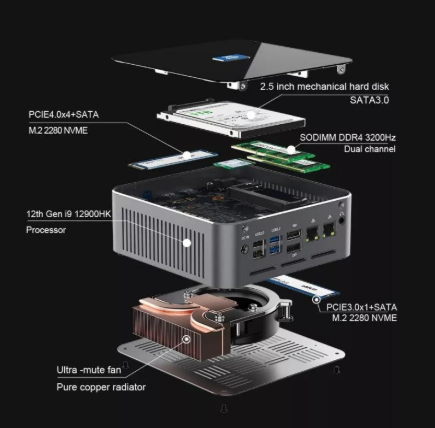
Industrial tablet PCs offer greater practicality and ruggedness.
Industrial manufacturing environments are incredibly harsh, with common challenges including dust, vibration, liquid spills, electromagnetic noise, and extreme temperature fluctuations. Consumer hardware is prone to failure in such environments. Industrial tablet PCs are designed to address these realities, with typical requirements including IP ratings, MIL-STD shock/vibration ratings, wide operating temperature ranges, and replaceable, field-serviceable parts. These building blocks translate into increased uptime and predictable maintenance costs.
Key rugged features are essential. When selecting an industrial tablet pc, adhere to precise environmental specifications, including the operating temperature range (e.g., -20°C to +60°C), ingress protection (IP65/IP67 if exposed to outdoor conditions), and shock/vibration ratings (MIL-STD-810G or similar). Furthermore, industrial I/O should be mechanically robust—locking connectors, M12 Ethernet options, and captive fasteners reduce the risk of accidental disconnection during production shifts. Ruggedized industrial mini PCs also typically have longer production lifecycles, enabling standardized imaging and reducing validation costs. The ZKS600‘s design supports this extended lifecycle, and combined with robust cooling and component selection, it helps achieve predictable maintenance intervals and reduce unplanned downtime.
Floor-standing interface set for integrated systems
Industrial manufacturing often relies on a variety of interfaces: multiple Ethernet ports for VLAN networking, real-time I/O, serial links for legacy devices, GPIO for sensors and actuators, and robust wireless connectivity for mobile workflows. A powerful industrial tablet PC offers a rich and easy-to-maintain I/O matrix, reducing gateway point failures and simplifying cabling topologies.
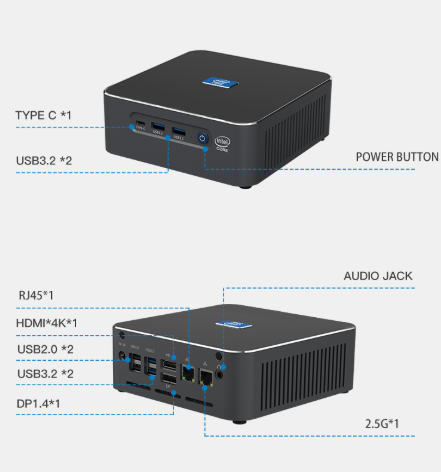
The ZKS600 supports dual 2.5G + 1G RJ45 connections, making it ideal for edge devices requiring fast uplinks to local aggregation switches and isolated connections for PLCs or machine sensors. Many production equipment still relies on RS-232/485 or fieldbus standards, and industrial panel PCs often include serial breakout options or PCIe expansion for fieldbus cards. For example, connecting barcode/QR code scanners, scales, and older motion controllers requires reliable serial ports and electrical isolation, features typically integrated into dedicated devices.
For high-mobility industrial scenarios, integrated Wi-Fi 6/6E and an optional 5G modem are essential. Industrial tablets typically include high-gain antennas and eSIM support for secure cellular failover. The ZKS600’s expanded capabilities support flexible network topologies and multiple redundant uplink strategies, reducing single points of failure in connected manufacturing.
Thermal Design and Continuous Reliability
Thermal engineering is an intangible advantage that distinguishes devices that operate continuously for hours under high load from those that throttle after peak hours. On the manufacturing floor, systems are rarely idle. Continuous inference, video encoding, and real-time HMI screens generate constant heat load. Poor thermal management can lead to CPU throttling, shortened component lifespans, and unpredictable failures.
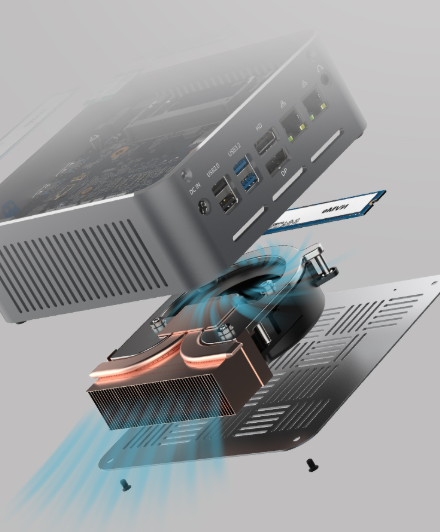
Why is robust cooling so crucial for industrial workloads? Many industrial tasks require continuous computing, such as 24/7 visual inspection pipelines, edge aggregation of sensor data streams, and local control simulations. CPUs like the Intel Core i9-12900HK deliver exceptional single-threaded and multi-threaded performance, but they require effective cooling to avoid thermal throttling. The ZKS600 features a pure copper heatsink with ultra-quiet, large fans. Copper’s high thermal conductivity quickly transfers heat from the processor and NVMe drives to the heatsink, while the large, low-speed fan provides high-volume airflow and reduces acoustic impact.
Reducing Total Cost of Ownership in Large-Scale Deployments
A final advantage of industrial tablet PCs is their ability to reduce the total cost of ownership in large-scale deployments: centralized management, extended lifecycle support, and easily integrated hardware accelerate deployment and reduce maintenance costs. Manufacturers benefit significantly when devices ship with a validated operating system image, including drivers, security hardening, and a remote management agent. Support for MDM/EMM tools and PXE or secure configuration services reduces commissioning time. zkmagic’s ZKS600 is designed for enterprise imaging and supports standard tools, including Microsoft Autopilot, SCCM, and Linux-based fleet management systems. This reduces field technician time and ensures consistent builds across production lines.
The Biggest Advantage of Industrial Mini PCs
In manufacturing, industrial tablet PCs provide predictable, continuous computing and connectivity when needed, enabling low-latency, highly resilient, and integrated production operations that consumer devices cannot reliably provide. This advantage is reflected in lower defect rates, higher throughput, a simplified architecture, and reduced operational risk when scaling across factories. The ZKS600 exemplifies this advantage, featuring a powerful 12th Gen Intel Core i9-12900HK processor, up to 64GB of dual-channel memory, triple high-speed storage (supporting dual M.2 NVMe PCIe 4.0 and PCIe 3.0 2.5-inch HDDs), dual 2.5G+1G RJ45 network ports, and an efficient copper heatsink with a silent fan cooling design, ensuring sustained performance under real-world production loads.