
A large warehouse purchased 12 fanless mini PCs equipped with Celeron processors to run an inventory management system. Within weeks, these PCs were crashing daily—barcode scanning software, cloud synchronization tools, and CCTV monitoring systems running simultaneously overwhelmed the system. Before being replaced with models equipped with Core i5 processors, the downtime resulted in tens of thousands of dollars in lost orders. This is a common occurrence, as many fanless mini PC users regret their initial choice of Celeron processors—either the Celeron was inadequate for their tasks, or the Core processors were overkill. Therefore, for anyone considering buying a fanless mini PC, the choice between Celeron and Core is not just about specifications; more importantly, it is about matching performance to the intended use.
Choose the right processor for a fanless mini PC for passive cooling.
Fanless mini PCs lack fans for cooling; they rely on heatsinks and the device’s metal chassis to keep components cool. This makes the processor the most critical element, and choosing the wrong one can lead to two key problems.
The first is overheating; processors with excessively high TDPs will generate heat exceeding the cooling capacity of the fanless chassis. Over time, this can lead to performance degradation (slower operation) or permanent damage. The second issue is insufficient performance; processors with too low a TDP can even struggle with basic tasks, turning your fanless mini PC into a frustratingly slow device.
Celeron and Core processors are designed for different TDP ranges and performance levels:
Celeron: TDP 6–15W – Low heat generation, basic performance, ideal for single-tasking.
Core (i3/i5/i7): TDP 15–28W (fanless optimized models) – Higher performance, better cooling, designed for multitasking.
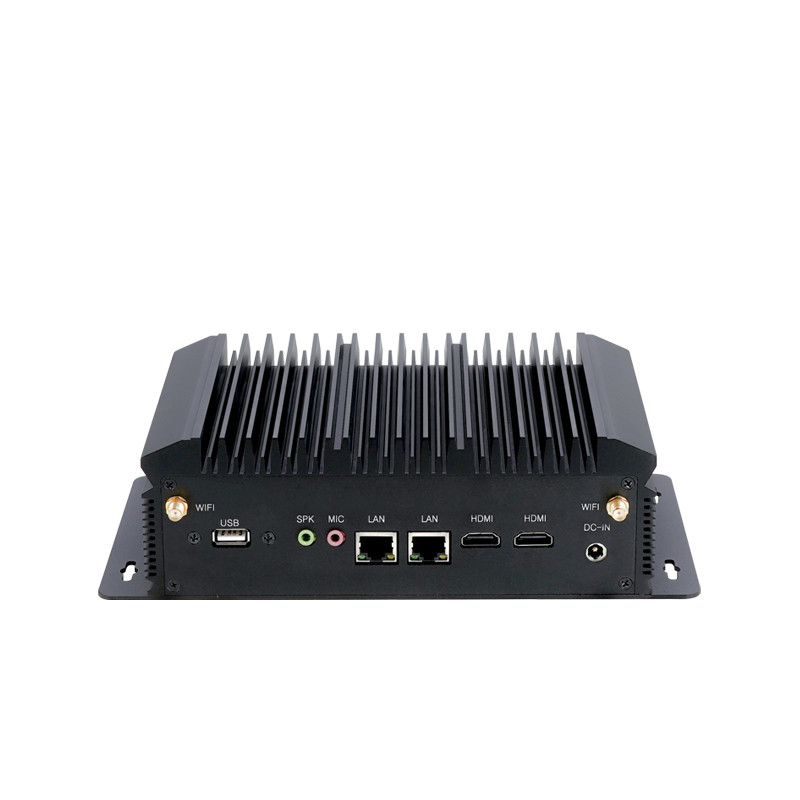
Celeron processors are the best choice for light and basic industrial tasks.
Celeron processors are the mainstay processors for entry-level fanless mini PCs. They offer low power consumption (6-15W) and straightforward performance, making them ideal for tasks with low computational demands: The main advantage of Celeron processors in fanless mini-PCs lies in their energy efficiency. With a TDP of 6-15W, Celeron processors are extremely low-power, making them ideal for off-grid setups or industrial mini-PCs operating 24/7 on a low-power budget. They also provide reliable single-tasking capabilities, efficiently handling web browsing, word processing, media streaming, and basic industrial tasks.
Furthermore, fanless mini PCs equipped with Celeron processors are 30-40% cheaper than those with Core processors, making them ideal for bulk purchases. These are suitable for tasks requiring stability rather than high performance, where 24/7 reliability and low power consumption are more important than multitasking.
Core processors offer powerful multitasking capabilities and performance for complex industrial tasks.
Core processors (Intel Core i3, i5, i7) are a high-performance option for fanless mini-PCs, provided that models optimized for passive cooling (TDP 15–28W) are selected. These processors deliver powerful performance to handle demanding tasks without overheating.
Core’s main advantage in fanless mini PCs lies in its multitasking capabilities. Core processors can handle multiple demanding applications simultaneously. For example, an industrial mini PC in a warehouse might run barcode software, cloud synchronization, and CCTV monitoring, or a remote worker might use Slack, Excel, and video conferencing.
Meanwhile, Core i5/i7 models can easily handle lightweight content creation. Furthermore, Core’s additional performance ensures your fanless mini PC can handle new software or expanded tasks without needing replacement. In practical applications, warehouses use industrial mini PCs equipped with Core i5 processors for inventory management—running three resource-intensive applications simultaneously, 24/7, without any performance limitations. Therefore, Core’s advantage lies in its ability to handle multiple tasks simultaneously, whether for consumer or industrial users.
Celeron vs. Core Processors—Key Comparison Factors
Choosing a processor for a fanless mini PC, whether Celeron or Core, depends primarily on five key factors.
Task Intensity:
If you only need to perform a single task (such as web browsing or basic industrial data logging), choose a Celeron processor. If you need multitasking or heavy workloads, select a Core processor.
TDP Compatibility: Fanless mini PCs typically support TDPs up to 28W. Celeron processors are better suited for small chassis; Core processors are suitable for larger models with heatsinks (standard in industrial mini PCs).
Usage Duration:
Both are suitable for 24/7 use (crucial for industrial mini PCs), but Core’s optimized thermal management makes it more reliable for long-term heavy use.
Industrial vs. Consumer Use:
Celeron: Ideal for basic industrial tasks and consumer media centers/office PCs.
Core: Better suited for complex industrial work and advanced consumer settings.
Fanless Mini PC: A Step-by-Step Guide to Choosing a Celeron or Core Processor
Choose the perfect processor for your fanless mini PC in just four simple steps:
List Your Daily Tasks: Write down every application or task you will be running.
Lightweight: Choose Celeron if you only run one application at a time.
Heavy-duty applications: Choose the core for multiple applications or complex tasks (video editing, edge computing).
Check TDP compatibility: Confirm the maximum TDP supported by your fanless mini PC. For a maximum TDP of 15W, choose Celeron; for a maximum TDP of 28W, select Core.
Adjust according to your budget: If heavy-duty tasks are essential, invest in a Core processor; if basic performance is sufficient, choose a Celeron processor to save costs.
For industrial-grade mini PC buyers: Add a fifth step—confirm the processor’s rated operating temperature range is industrial-grade (-40°C to 70°C). Both Celeron and Core offer industrial-grade models, but you must verify their compatibility.
Choose based on your needs, not on which is “better”.
For users of fanless mini PCs, the debate between Celeron and Core processors boils down to one question: What will you be using it for? Celeron processors excel at light tasks, basic industrial applications, and budget configurations, providing reliable, energy-efficient performance without overheating. Core processors are better suited for multitasking, complex industrial computing, and high-end users. They deliver powerful performance and can easily handle heavy tasks, even in fanless chassis, while maintaining low temperatures.