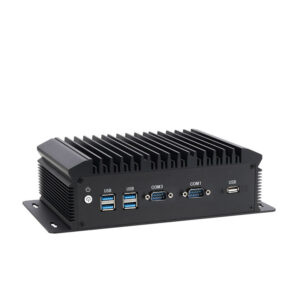
Unplanned downtime in industrial systems costs US manufacturers an average of 10,000 dollars per hour each year, potentially leading to missed deadlines and production delays. Therefore, mini PCs used in industrial environments need to be more than just “fanless”; they must possess specialized features to operate correctly in these harsh industrial environments. As an industrial mini PC manufacturer, we will discuss the seven key features that fanless industrial mini PCs must possess for reliable, 24/7 operation. From passive cooling to remote management, we ensure your system runs smoothly under all conditions.
Fanless Industrial Mini PC: Passive Cooling Design, No Failure Points
The most notable feature of fanless industrial mini PCs is their passive cooling system, which must be specifically designed for 24/7 heat dissipation, not just “fanless.” While traditional mini PCs use fans to dissipate hot air, fanless models rely on heat sinks, thermal pads, and chassis design to dissipate heat away from components.
Unibody Aluminum Chassis: Aluminum conducts heat three times faster than plastic, making a chassis that doubles as a heatsink ideal. For example, the 2mm-thick aluminum frame of our fanless industrial mini PCs distributes heat evenly throughout the system, preventing hot spots.
Integrated Copper Heat Pipes: For high-performance industrial tasks, copper heat pipes transfer heat from the CPU to the chassis in seconds, which is critical for continuous 24/7 use.
Optimized Airflow: Even without a fan, the chassis should have strategically placed vents to circulate cool air passively. Avoid fully sealed designs, as they trap heat and shorten component life.
A fanless industrial mini PC should have a wide temperature range to withstand extreme environments.
Industrial facilities lack climate control. Consumer-grade fanless mini PCs (rated for 0-40°C) would fail in these extreme environments. However, fanless industrial mini PCs must be able to withstand temperatures ranging from -20°C to 60°C for 24/7 operation. Therefore, industrial mini PCs utilize at least the Intel Celeron N5105 industrial-grade CPU and wide-temperature capacitors. These components will not freeze, deform, or experience performance degradation under harsh conditions.
At the same time, they must also meet low power consumption requirements. Fanless industrial mini PCs consume only 15-30W, generating less initial heat, which is crucial in high-temperature environments. They must also provide cold start protection, with built-in heaters that warm components to 5°C before startup to prevent damage from cold starts.

Rugged and durable—dustproof, shockproof, and impact-resistant
Industrial environments place stringent demands on equipment. Dust can clog fans (even passive vents), mechanical vibration can loosen parts, and accidental collisions can damage delicate components. Therefore, fanless industrial mini PCs must possess a rugged and durable construction to withstand these challenges. Fanless industrial mini PCs must achieve at least an IP50+ dustproof rating. This rating means the system prevents dust from entering critical components, vents should be equipped with dust filters, and I/O ports should be sealed. Zkmagic’s fanless industrial mini PCs are available in IP65-rated models, providing added protection in dusty warehouses.
They also need to meet MIL-STD-810H standards for vibration and shock resistance, which is crucial for assembly lines or mobile industrial carts. One building materials factory reported that their fanless industrial mini PCs survived a 3-foot (9-meter) drop from a workbench to a concrete floor and continued to operate normally. “With a consumer-grade mini PC, we would have had to replace the entire system.”
Stable power supply to withstand voltage fluctuations and surges
Industrial power grids are prone to voltage fluctuations. Voltage spikes from mechanical equipment or voltage dips during peak hours can cause an unprotected mini PC to crash. Fanless industrial mini PCs require a stable power supply system for 24/7 operation. They need a broad voltage input, supporting 12-24V DC, to be compatible with industrial power supplies and backup batteries.
Surge and overcurrent protection are also required. Built-in surge protectors divert excessive voltage away from components. At the same time, overcurrent protection temporarily shuts down the system during current spikes to prevent damage. Of course, integration with an industrial UPS system is also necessary to ensure the mini PC continues to operate during power outages.
Industrial-grade I/O and Expandability
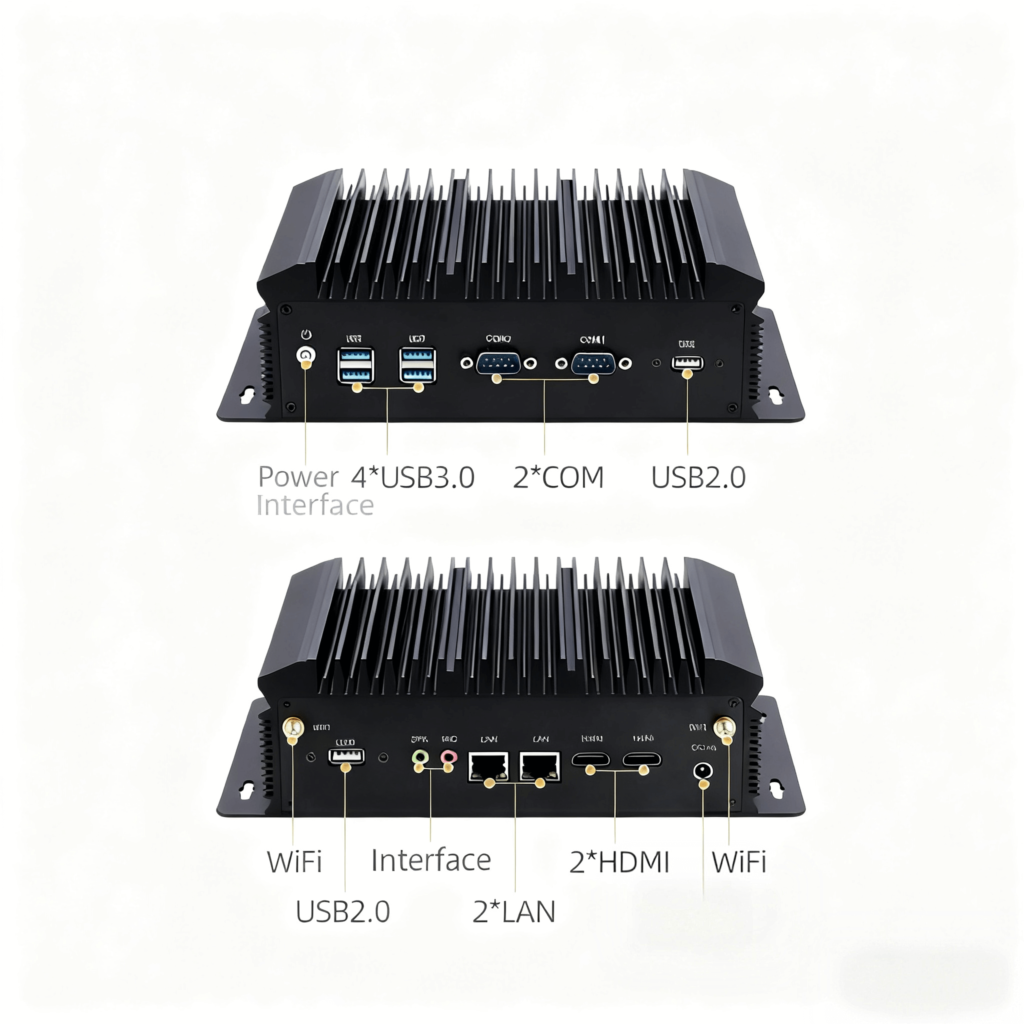
A fanless industrial mini PC is useless without connectivity to industrial equipment. Unlike consumer-grade mini PCs, it requires dedicated ports and expandability for 24/7 operation. These include RS-485/RS-232 ports, Gigabit Ethernet, and USB 3.0 ports. Expansion slots, such as PCIe or M.2 slots, are also required for adding Wi-Fi 6, 4G/LT, or additional storage. Furthermore, compatibility with other industrial tablets in the factory is essential for anytime, anywhere monitoring. This allows access to data from the fanless mini PC and allows for data to be captured from anywhere on the factory floor.
Designed for 24/7 Industrial Reliability
A fanless industrial mini PC is more than just a fanless version of a consumer mini PC; it’s a professional tool designed to eliminate downtime in the harshest 24/7 environments. Key features—passive cooling, a wide operating temperature range, rugged durability, stable power supply, industrial-grade I/O, and remote management—work together to ensure your system runs smoothly under any conditions.